The Art Deco movement of the 1920s and ‘30s came at the height of the French colonial empire when 10 percent of the world was under the control of France, and goods, materials and new forms of art were flowing into the country from Africa and Asia.
The Purist faction of Art Deco, led by architect Le Corbusier (who designed the National Museum of Western Art, Tokyo), eschewed the frivolous, gaudy designs preferred by France’s rich, and took a minimalist approach, preferring raw materials stripped to their natural state.
Along with this return to the au naturel came an appreciation for the purity of the male and female nude form, perhaps most readily recognized in Paul Manship’s bronze Prometheus sculpture at New York City’s Rockefeller Center.
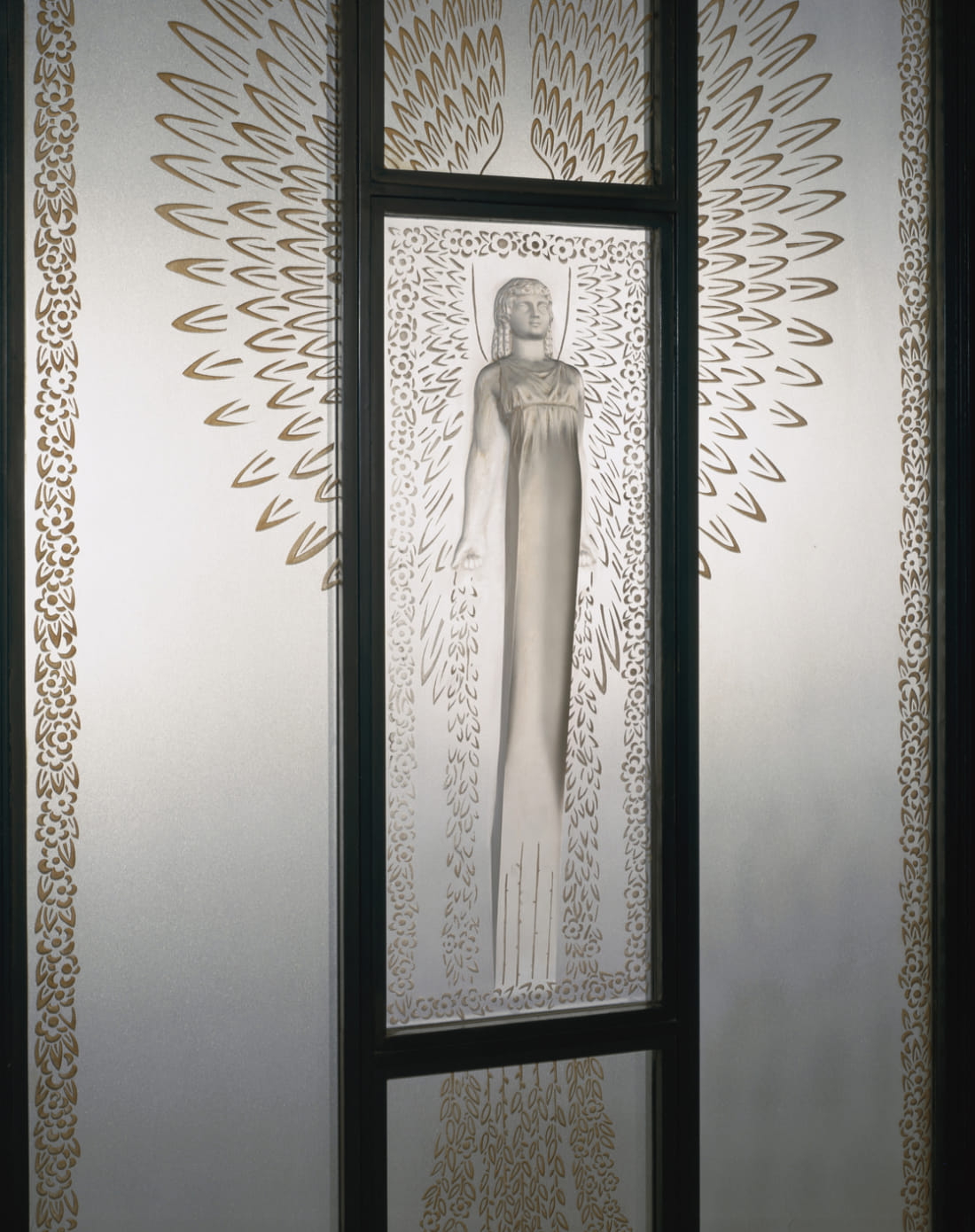
Former Asaka Palace House front entrance glass relief door (partial), 1933, Collection of Tokyo Metropolitan Teien Art Museum
Introducing René Lalique
One of the most prominent artists of the Art Deco movement was French glassmaker René Lalique, whose work not only embraces the Japanese and Chinese landscape imagery preferred by Art Deco artists, but also the nude form.
When Prince Asaka Yasuhiko built his Tokyo residence in 1933, he commissioned Lalique to design the entrance doors, one of Lalique’s largest works in existence. His original etchings for the glass doors included four nude goddesses in classic Greek style. When the completed doors were delivered to the Art Deco manor in Shirokanedai, the goddesses arrived fully clothed.
Today, Lalique’s nudes are finally welcome inside Prince Asaka Yasuhiko’s mansion.
Technically, Lalique’s original drawings for the doors are now on full display in the annex of the Tokyo Metropolitan Teien Art Museum as part of the current exhibition, René Lalique – Modernity and Elegance: Art Deco Glass from the Kitazawa Museum of Art Collection.
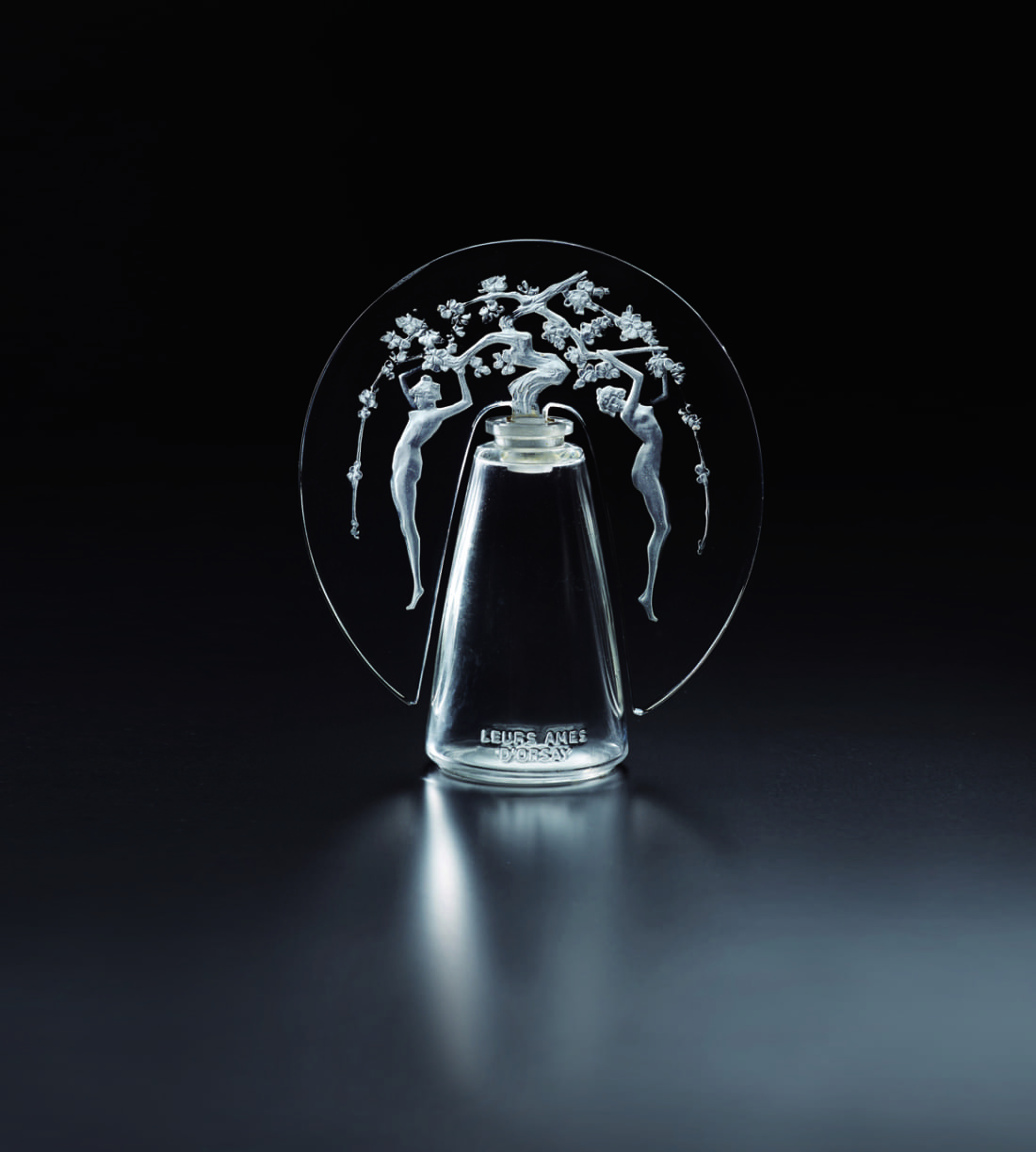
Perfume bottle “Their Soul” Dolsay, 1914 (Kitazawa Museum of Art), Photo by Takao Ogata
On Display at Tokyo’s Lalique Exhibition
The bulk of the immense collection of Lalique glassware, a total of 220 pieces chronicling the artist’s career, is showcased inside Prince Asaka Yasuhiko’s former residence, which is now the Tokyo Metropolitan Teien Art Museum (the annex was opened in 2014).
On display is a large collection of Lalique’s famous glass hood ornaments, once the ultimate status symbol for Rolls Royce and Bentley owners worldwide. The husband of the prince’s oldest sister, Marquis Nabeshima Naoyasu, owned one of Lalique’s striking car mascots.
There are elegant vases designed with kingfishers, dahlias and goldfish that could have come straight out of a Kuniyoshi ukiyo-e print. While Lalique never stepped foot in Japan, the Japonisme influence on French art was prominent early in his career, and his subtle, delicate nature scenes are reminiscent of Asian artwork.
There are plenty of nudes as well. A master of optics, Lalique’s opalescent vase “Bacchantes” permutates with orange and blue hues when sunlight flows through the glass. The large round box piece titled “Two Sirens” is a beautiful blend of classic Greek form, modern Art Deco style and Lalique’s masterful skill.
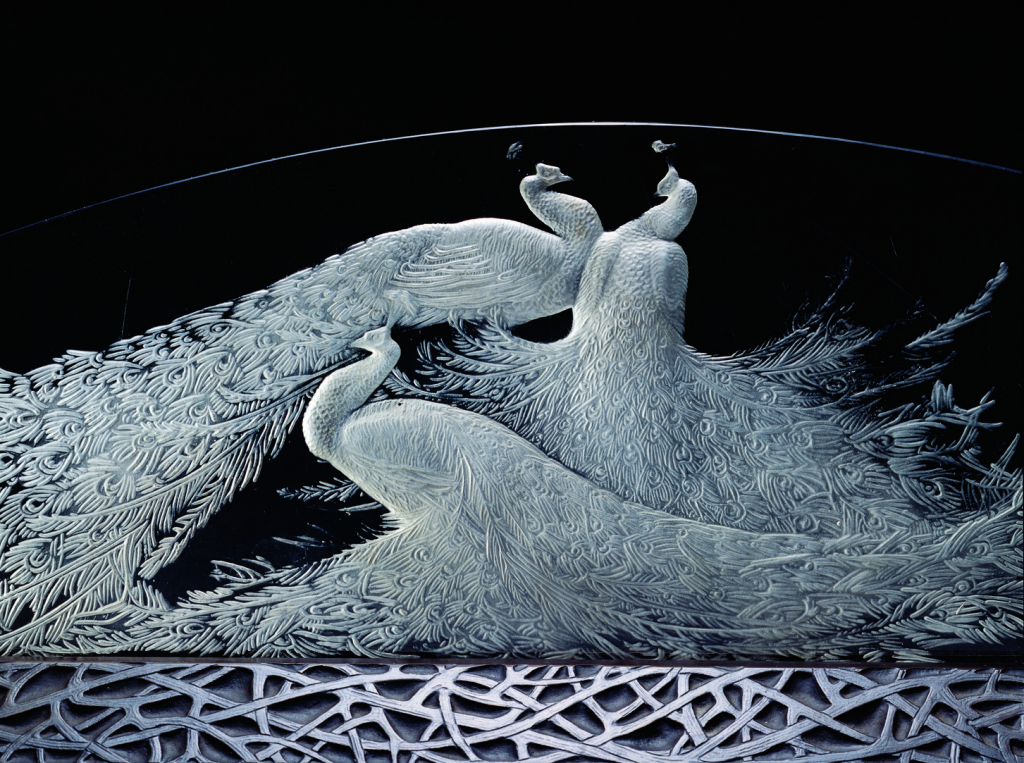
Mesmerized with the effects of electric light, Lalique created the centerpiece of the exhibit – a table centerpiece titled “Three Peacocks” – by plugging in the sculpture, and illuminating the chemically etched, gorgeous nature scene from beneath.
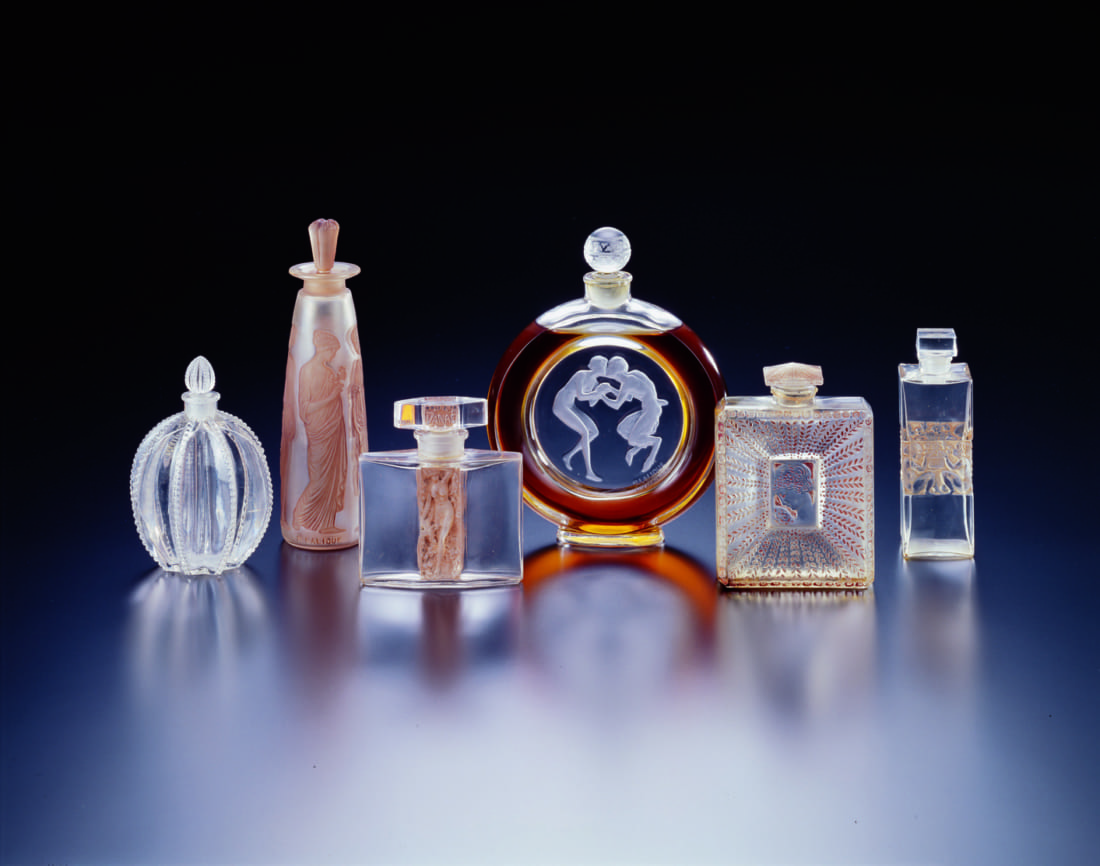
Perfume bottle “King of the Faun,” Molinal Company, 1928 (third from right) and other perfume bottles, at the Kitazawa Museum of Art, photographed by Tetsuro Shimizu
Who is René Lalique?
A gifted goldsmith, Lalique apprenticed with Paris’ top jeweler as a teenager and early in his career he designed avant-garde jewelry for Cartier, Boucheron and others, winning the Grand Prix at the 1900 Exposition Universelle in Paris.
He became fully committed to glassware in his 40s, and in true French Art Deco style Lalique worked mainly with unembellished, transparent glass, with a desire to produce art for the masses. His first collaboration was creating bottles for French perfumer François Coty, many of which are on now display in the royal family’s former smoking room.
By the 1920s Lalique was receiving commissions from around the world. In 1921 Crown Prince Hirohito brought the first Lalique to Japan (a vase – “Parakeets” – also now on display).
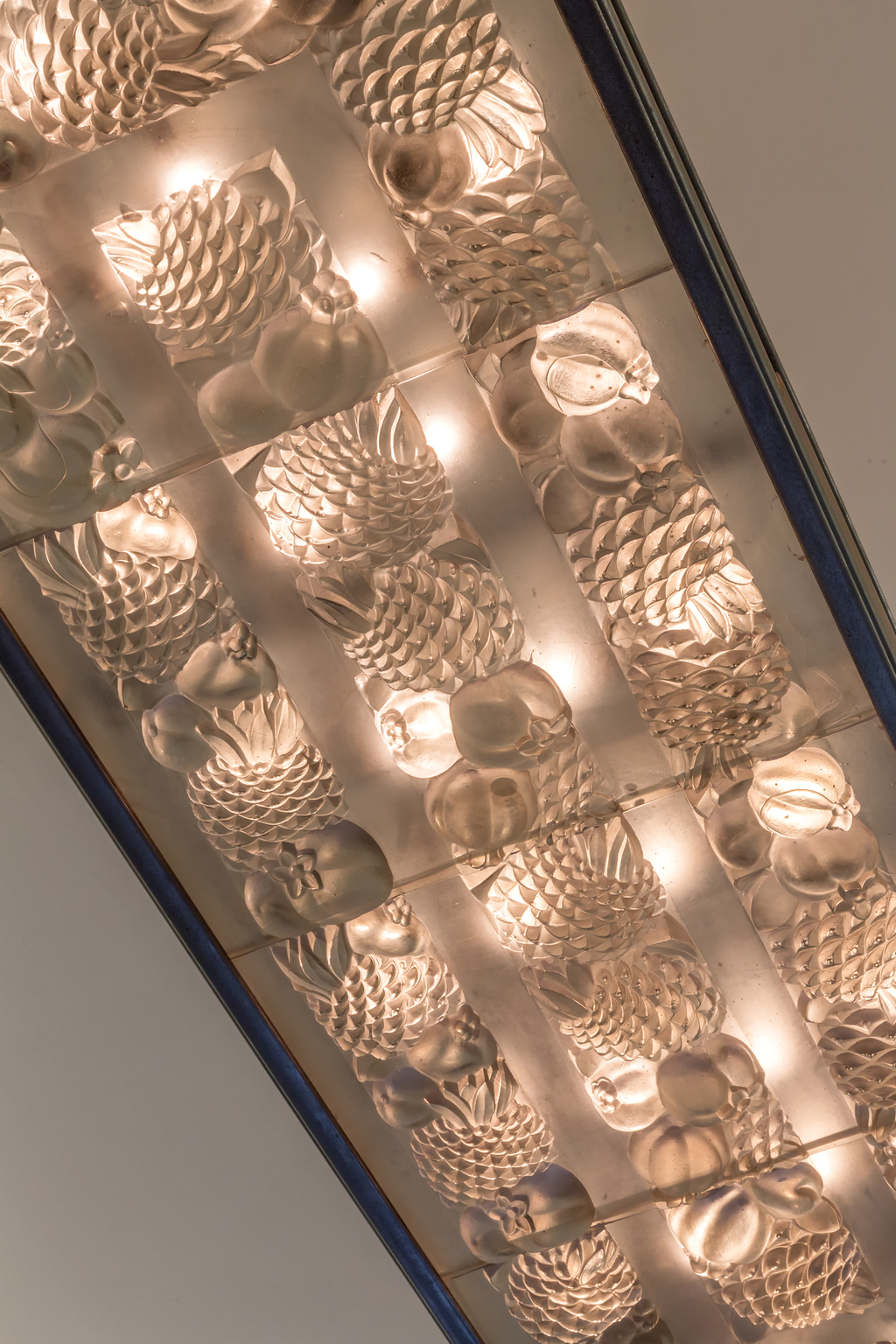
Tokyo Metropolitan Teien Art Museum Main Building, Large dining room @ chandelier “Pineapple and pomegranate” by Rene Lalique
Lalique’s Japan Connection
Prince Asaka Yasuhiko studied military tactics at the École Spéciale Militaire de Saint-Cyr in France. He was involved in a serious automobile accident and his wife moved to France to tend to him until he recovered from his injuries. They became enamored with the Art Deco movement and attended the 1925 International Exhibition of Modern Decorative and Industrial Arts, where Art Deco was introduced to the world.
One of the landmarks of the exhibition was the “Source of the Fountain” sculpture built outside the René Lalique Pavilion. Lalique stacked individual statuettes 15-meters-high and jets of water criss-crossed around the illuminated glass structure.
When the royal couple returned to Japan they commissioned Henri Rapin to design the interiors of their new residence, and Lalique to create custom glasswork, including the main doors and several light fixtures, including three lamps adorned with pineapples and pomegranates hanging aloft in the main dining room.
At the end of the dining room, underneath the Lalique lamps, is an elegant setting of tableware the artist titled “Nippon.” The cone-shaped glasses are simple, the beaded texture at the base of the cups matching the design of the candlesticks.
The plates are etched with simple stocks of rice, the grains fully ripe, a symbol of the pure and fruitful marriage between Japan and the Art Deco movement’s preeminent glass artist.
The René Lalique – Modernity and Elegance: Art Deco Glass from the Kitazawa Museum of Art Collection is at Tokyo Metropolitan Teien Art Museum was unfortunately canceled.
Feature image: Table Centerpiece “Three Peacocks” (part) 1920, Collection of Kitazawa Museum of Art, Photo by Tetsuro Shimizu

Author: Nick Narigon
Nick, from Cedar Falls, USA, is TW's Editor in Chief. From a musical household in the Midwest, Nick is the literal definition of a musicophile. After tasting fame with his band Skoob at his junior high talent show at age 14, Nick was forever chasing the applause until eventually deciding to focus on being a writer in college (since the world wasn’t ready for avant garde psy-acid bluegrass). Nick took the opportunity to combine his two passions, with music and the arts often present in many of his written works. We could go on for ages talking about Nick’s journalistic prowess and all of the high profile publications the guy has written for, but let’s not forget his other big achievements: spearheading the TW Live House project and his dad bod. Since moving to Tokyo, his work has allowed him to explore much of the local music scene, and in a perfect world, Nick would like to spend more time writing and less time reading.